
Most "alternatives to plastic" fail one of two tests: they don't perform, or they don't scale.
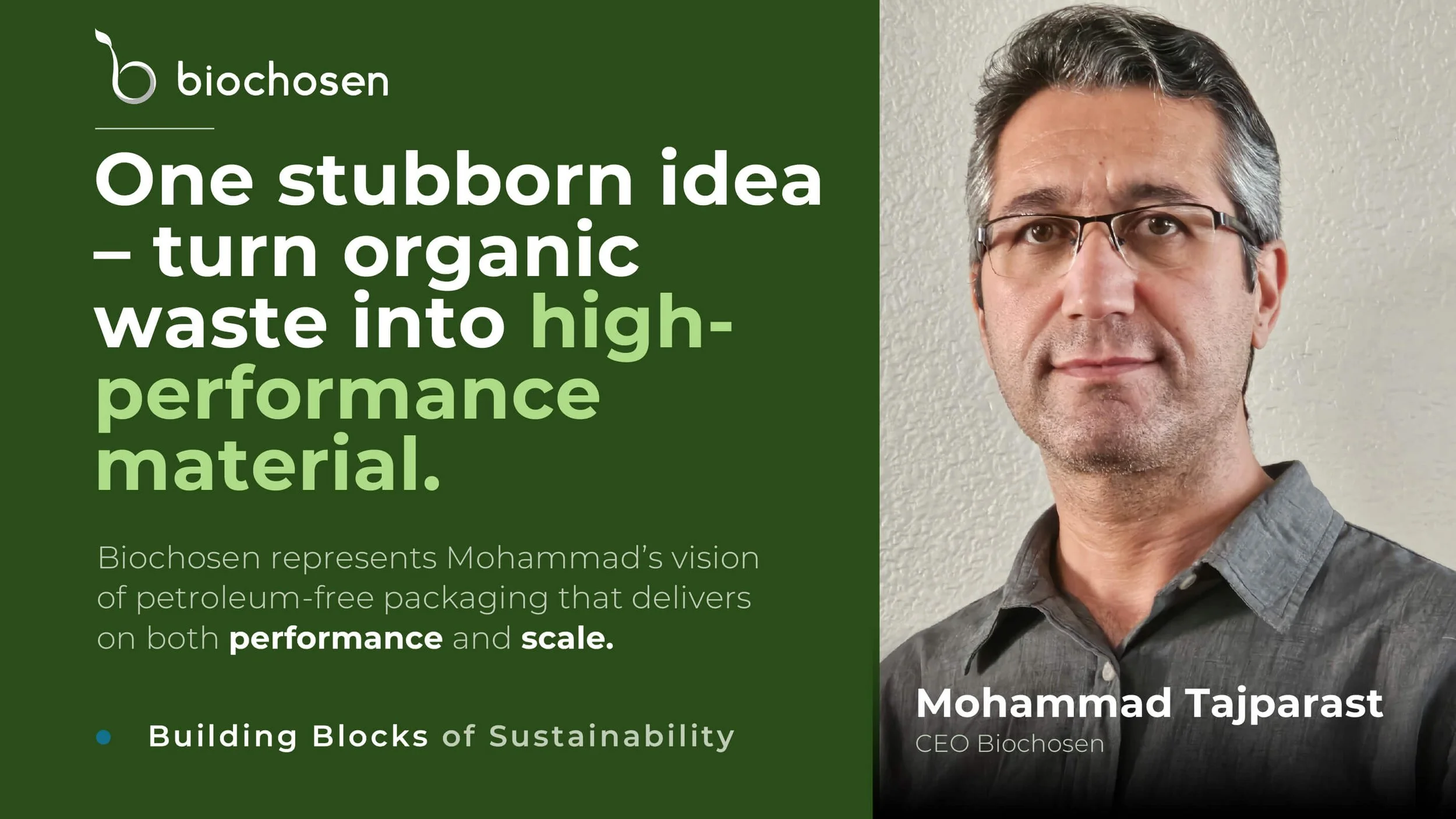
Mohammad has spent 25 years working on the version that does both.
He studied bioprocessing and the bioproduction of value-added compounds in the late 1990s, modeled polymer thermodynamics and kinetics through his PhD at McGill, and from 2008 onward focused on a single, stubborn idea: that the carbon already sitting in our waste streams could become high-performance biopolymers instead of pollution. Wastewater into PHA bioplastic. Seaweed, agri-food pomace, lignocellulosic and nut-shell waste, biosolids — into polysaccharides, proteins, fibers, and lipids. And those, in turn, into films, bags, rigid parts, and biofoam.
This is the foundation of Biochosen and our material, Ecochosen — a biocomposite of naturally occurring, biodegradable ingredients, engineered for real-world durability and home-compostable at the end of its life. Because the inputs come from abundant organic waste, the more we scale, the more circular it becomes.
For brand sustainability leaders: this is a credible, performance-tested route away from petroleum-based packaging.
For waste management and those looking for a new solution to our plastic problem to help us hit our circular-economy goals: this is exactly the kind of waste-valorization and bioplastic platform that turns diversion targets into manufactured products.
We're early, and we're honest about that. But the science is decades deep. Tell us about the packaging problem you're trying to solve, and let's see if Ecochosen fits.